
To restart a daily walking routine after a break, shrink your immediate target to a frictionless baseline—such as a simple 5- to 10-minute walk—and schedule it adjacent to an established daily habit. The biggest obstacle to resuming a walking practice is rarely physical conditioning; it is the mental weight of trying to match your previous peak performance on day one.
Breaks happen to everyone due to illness, travel, shifting schedules, bad weather, or plain burnout. Attempting to leap directly back into an ambitious 10,000-step target or a rigid 60-minute daily session often creates unnecessary resistance and early fatigue. By lowering your barrier to entry, removing streak anxiety, and establishing small process-focused wins, you can rebuild durable momentum that lasts.
Here is how to release the pressure of a broken streak and successfully ease back into a daily walking routine you will actually look forward to.
Lower the barrier to entry with micro-commitments
When re-establishing a walking habit, your only objective during the first week is showing up consistently. The physical volume matters far less than the neural reinforcement of putting on your walking shoes and stepping outside.
Begin with a commitment so small that excuses become impossible. If you previously walked for 45 minutes every morning, reset your initial benchmark to 10 minutes. According to the U.S. Physical Activity Guidelines, physical activity can be accumulated in shorter bouts across the day, and any movement is significantly better than remaining sedentary. A brief 10-minute walk around the block eliminates decision fatigue and allows your mind to register a completed routine without feeling overwhelmed.
Pair this micro-walk with an anchor that already exists in your daily schedule. Link your walk directly to your morning coffee, the end of your lunch break, or stepping away from your desk at the end of the workday. By using habit stacking, the existing behavior serves as an automatic cue, eliminating the need to debate whether you have time to walk.
Let go of streak perfection and celebrate trends
One of the primary reasons people struggle to resume walking after a lapse is the psychological trap of broken streaks. Habit trackers that reset your count to zero when life gets in the way can make you feel as though all prior progress has been erased. In reality, fitness adaptations and behavioral foundations do not vanish because of a few missed days.
Research on habit formation led by Dr. Phillippa Lally at University College London revealed that missing an occasional day does not materially impact the long-term process of establishing automaticity. Habit formation is not an all-or-nothing endeavor; it is a gradual learning curve driven by overall consistency across weeks and months rather than an uninterrupted chain of perfect days.
Shift your definition of success from unbroken streaks to monthly movement patterns. If you walk four out of seven days this week, that is four days of cardiovascular, joint, and mental health benefits that you would not have had otherwise. Aim for consistency over perfection.
Review your monthly rhythm with the GoAtlas Step History Calendar
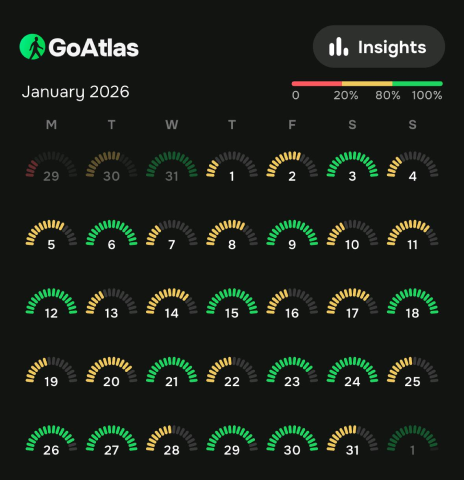
When rebuilding a sustainable routine, visual feedback should encourage progress rather than penalize normal disruptions. GoAtlas approaches daily movement through this lens, turning your real daily steps into progress along walking routes while maintaining a clear, non-punitive record of your habits.
Within the GoAtlas Step History Calendar, you can review a full month of walking activity at a glance. Instead of tracking a fragile streak that breaks when a busy day occurs, the calendar shades each day based on your progress toward your chosen daily step goal. A lighter shade marks days with lighter movement, while deeper shades highlight days when you met or approached your target.
This monthly view helps you evaluate your walking routine as an overall pattern rather than a pass-fail test. Seeing a calendar populated with consistent shades—even with lighter days interspersed—reinforces the reality that lifestyle habits fluctuate naturally. GoAtlas provides a visual way to appreciate your cumulative movement, helping you stay motivated without the stress of perfectionism.
Progress gradually toward your long-term movement goals
Once you have established five to seven consecutive days of showing up for your low-friction baseline walk, you can begin progressively building back toward your long-term targets. Avoid doubling your distance overnight; steady, incremental increases protect your joints and prevent mental burnout.
Use the 10 percent guideline: increase either your daily step count or total walking duration by no more than roughly 10 percent each week. If you began your restart by walking 15 minutes a day, expand those outings to 17 or 18 minutes the following week, or add a short second walk after dinner.
The Centers for Disease Control and Prevention and HHS recommend that adults achieve at least 150 minutes of moderate-intensity aerobic activity each week. Breaking this down into manageable chunks—such as 20 to 30 minutes five days a week—makes the goal accessible and realistic. As your energy returns and your routine solidifies, you will find yourself meeting and exceeding these benchmarks naturally, without forcing the process.
Try this on your next walk
Before you step out the door for your next walk, intentionally cap your session at exactly 10 minutes, turn around at the 5-minute mark, and log it as a complete success. Do not try to make up for lost time by staying out longer, even if you feel great. Finishing while you still have energy leaves you with positive momentum and eager to step out again tomorrow.